The South Asian Wedding Planning Guide for 2026: Every Function, Vendor & Budget
Mehndi, Sangeet, Baraat, Ceremony, Reception — a South Asian wedding is not one event, it is five. Here is how to plan all of them: the functions, the specialist vendors, the budgeting, and the technology built to hold it together.
A South Asian wedding is not one event. It is five — and you are planning all of them at once.
If you are planning a South Asian wedding in 2026, the first thing to understand is also the thing that breaks every mainstream planning tool: you are not organising a wedding day. You are producing a multi-day celebration in which the Mehndi, the Sangeet, the Baraat and Ceremony, and the Reception are each, in effect, their own event — with their own guest list, their own dress code, their own menu, their own vendors, and their own timeline. The couple does not change. Almost everything else does.
This guide walks through the full structure of a contemporary South Asian wedding — the functions, the vendor categories you actually need, how to budget when you are paying for four or five events instead of one, and why a dedicated platform exists for this market when generic wedding sites treat it as an afterthought. It is written for couples and families across the diaspora — Canada, the UK, the United States, Australia — where South Asian weddings have become one of the largest and most under-served segments in the entire wedding economy.
South Asian weddings span many traditions — Hindu, Sikh, Muslim, Jain, Christian, and secular, drawing on Punjabi, Gujarati, Tamil, Bengali, Pakistani, Sri Lankan, and dozens of other regional customs. No single guide can be definitive for every family. What is consistent across nearly all of them is the structure: multiple functions over multiple days, large guest lists, serious dietary complexity, and a set of specialist vendors that simply do not appear on the average Western planning platform. Plan for that structure and you are most of the way there.
The Multi-Day Structure
The five core functions — and what each one demands of you
Different families add, remove, or rename events, but the spine of a modern South Asian wedding is remarkably consistent. Here is the core sequence and what each function asks of the planning team. Treat each as a project in its own right.
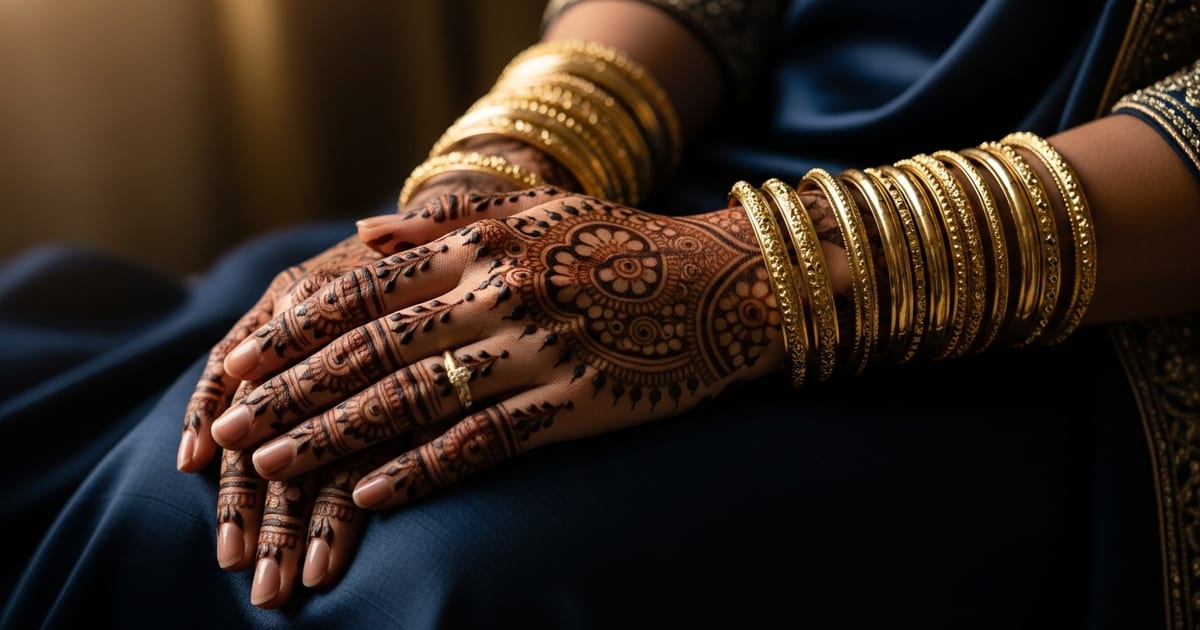
Mehndi
The henna celebration, usually for the bride and her close circle. Intimate to mid-sized. Needs henna artists booked by the hour for the number of hands, a relaxed décor scheme, lighter catering, and a guest list that is often the smallest of the week. Frequently paired or merged with a Haldi (turmeric) ceremony.
Sangeet
The music and dance night. Often the largest, most production-heavy function — choreographed performances, a DJ or live musicians, a stage, full bar where appropriate, and dinner for a big crowd. This is where audio-visual, lighting, and a proper venue with a dance floor matter most.
Baraat
The groom's procession to the ceremony — dhol players, sometimes a horse or open car, and a high-energy street arrival. Needs a dhol team, procession permits or venue coordination, and tight timeline management so the Baraat flows directly into the ceremony.
Ceremony
The religious or civil rite itself — under a mandap for Hindu weddings, in a gurdwara or with the Anand Karaj for Sikh, a Nikah for Muslim ceremonies. Needs the officiant or priest, the mandap or stage, specific ritual items, and seating that respects family hierarchy and tradition.
Reception
The grand celebration and dinner, often the most formal and the largest guest list. Full catering, premium décor, entertainment, a head table, and frequently a separate, more polished outfit for the couple. Muslim families may hold a separate Walima hosted by the groom's side.
Roka · Tilak · Haldi
Pre-wedding functions that many families include — the Roka or engagement, the Tilak, the Haldi turmeric ceremony, and an Ardas or prayer gathering. Each adds another guest list and another set of vendor and catering decisions to track.
Notice what every one of those cards has in common: a distinct guest list, a distinct menu, and a distinct vendor team. A couple might invite 120 people to the Mehndi, 450 to the Sangeet, 300 to the Ceremony, and 600 to the Reception — with heavy overlap but no single master list that fits all four. This is the single most important planning insight in this entire guide, and it is the precise point at which a tool designed for one wedding day stops being useful.
The Vendors
The specialist vendors generic platforms don't list — and you can't skip
Every wedding needs a venue, a caterer, and a photographer. A South Asian wedding needs those too — but it also needs an entire category of specialist vendors that mainstream directories either don't carry or bury under three irrelevant results. If you have ever searched a major Western wedding site for “mandap” or “dhol” and come up empty, you already know the problem. These are the vendors that make a South Asian wedding what it is.
- → Mandap & stage designers — the structure under which Hindu ceremonies take place, plus the Sangeet and Reception stages; a craft and rental category of its own
- → Dhol players & Baraat coordination — live percussion for the procession, sometimes with a horse, dhol-and-brass ensemble, or DJ truck
- → Mehndi / henna artists — priced and booked by the complexity and number of hands, often for both the bride and dozens of guests
- → Bridal makeup & hair — artists experienced with South Asian bridal looks, skin tones, and multi-day styling across different outfits
- → Décor & floral specialists — garlands (jaimala), draping, floral installations, and the heavy décor that defines the Sangeet and Reception
- → South Asian catering — regional cuisines done authentically, with proper dietary segregation across Jain, Halal, vegetarian, and allergy needs
- → Priests, officiants & ritual specialists — pandits, gurdwara coordination, Nikah officiants, and the ritual items each requires
- → Attire & jewellery — lehengas, sherwanis, sarees, bridal jewellery sets, and the multiple outfits a multi-day event demands
Finding these vendors is genuinely hard on a generic platform — not because the vendors don't exist, but because the platform was never designed to categorise them. This is the structural gap that the Industry Army Marketing ecosystem was built to close. shaadi.ltd exists as a dedicated South Asian wedding platform precisely because these categories deserve a home, not a footnote. For the full breakdown of why a dedicated platform beats a bolted-on “cultural section,” see our companion piece, why shaadi.ltd exists as a dedicated South Asian platform.
Décor in particular tends to be the line item families most underestimate. A single mandap, two stages, garlands, draping, lighting, and floral installations across four functions can rival the cost of the venue itself. The decorator.tv and caterers.tv properties in the ecosystem exist so these heavy categories have real, searchable depth instead of a thin directory. When you assign a vendor, you want to assign them to a function — the decorator for the Sangeet stage is often not the decorator for the Reception.
The Money
Budget per function — not per wedding
Here is the costliest planning mistake in South Asian weddings: estimating one budget for “the wedding” when you are actually financing four or five distinct events. A couple who budgets as though they are planning a single reception will be blindsided by the second, third, and fourth catering invoice. The fix is structural — build the budget the same way the wedding is built: per function, then layer the cross-cutting costs on top.
Scale with every event
Venue, catering, décor, and entertainment repeat for each function. A 600-guest Reception dinner and a 450-guest Sangeet are two full catering contracts, not one. Estimate each function's venue, food, décor, and entertainment separately, then total them. This is where the real money lives.
Span the whole week
Photography and videography across all days, the couple's multiple outfits and jewellery, bridal makeup for each function, transport and the Baraat procession, and accommodation for out-of-town family. These don't belong to one function — they sit across the whole celebration. Budget them as a separate layer.
Guest count is the multiplier on everything. South Asian guest lists of 300 to 800 are normal, not exceptional, and every additional 100 guests ripples through catering, venue capacity, seating, and rentals across multiple functions at once. This is why per-function, per-guest tracking is not a luxury feature — it is the only way to keep a budget honest when the same person attends three of your five events and a different person attends only the Reception.
Almost always because the original number was a single-event estimate applied to a multi-event reality. Once you rebuild it function by function — Mehndi, Sangeet, Ceremony, Reception, plus the cross-cutting layer — the number stops being a surprise and starts being a plan. A platform that models each function as its own event with its own budget does this arithmetic for you instead of leaving it in a spreadsheet that was never designed for it.
The Family
This is a family project — which is why parents.ltd exists
A South Asian wedding is rarely planned by the couple alone. Parents, in-laws, and extended family are active stakeholders — often the hosts, frequently the budget-holders, and almost always deeply involved in the guest list, the menu, and the vendor decisions. Any honest planning guide has to account for that, because a tool that assumes two people making every decision in private misreads the entire dynamic.
This is the reasoning behind parents.ltd in the ecosystem — a recognition that the parents of the couple are first-class participants in a South Asian wedding, not bystanders. The guest list alone is often a negotiation across two families and several generations, with separate sub-lists for each side and each function. Seating respects hierarchy and relationship. The catering reflects family traditions. Planning software that lets multiple stakeholders collaborate, rather than locking everything to one account, matches how these weddings actually get made.
The Technology
How the weddings.io platform actually holds all of this
Everything in this guide — five functions, five guest lists, five menus, multi-faceted dietary tracking, specialist vendors, per-function budgeting, multi-stakeholder families — describes a set of requirements that a single-event tool cannot meet. That is the entire reason the weddings.io platform is built the way it is.
On weddings.io, each function is modelled as a separate event inside one wedding. The Mehndi, Sangeet, Baraat, Ceremony, and Reception each carry their own guest list, their own seating plan, their own vendor assignments, and their own timeline — while still rolling up into a single celebration you can see whole. Dietary tracking runs per guest, per function, across Jain, Halal, vegetarian, Kosher, and specific allergy requirements simultaneously, because a real South Asian guest list contains all of those at once. The platform is built for guest counts of 800-plus, not the 150-guest ceiling that quietly underpins most mainstream tools.
- → Each function — Mehndi, Sangeet, Baraat, Ceremony, Reception — is its own event with its own guest list, seating, vendors, and timeline
- → Per-guest, per-function dietary tracking across Jain, Halal, vegetarian, Kosher, and allergy needs at the same time
- → Guest management built for 800-plus, with per-function budgeting that sums to the true cost of the week
- → EyeSpyR™ vendor verification so specialist vendors are accountable, not just listed
- → AI couple-to-vendor matching that connects families to the mandap, dhol, henna, makeup, and catering specialists they actually need
Vendor trust matters more, not less, when you are coordinating five functions with deposits across a dozen specialists. That is what EyeSpyR™, the platform's vendor verification layer, is for — accountability around deposits, no-shows, and misrepresentation, so families are matched to vendors who show up and deliver. And the AI matching layer is built to connect couples with the precise specialist categories above, rather than returning a generic list and hoping for the best. For a deeper technical walkthrough of how the app handles a multi-day South Asian wedding event by event, read our companion deep dive on the South Asian wedding app architecture.
None of this is theoretical. weddings.io is a live production React platform, owned by Industry Army Marketing and operating across 1,018 cities in 24 countries, with shaadi.ltd as its dedicated South Asian home and weddings.ltd serving traditional and heritage weddings alongside it. The South Asian market is not a niche the ecosystem tolerates — it is one of the largest and most deliberately served segments in the entire network.
Plan It Right
A simple sequence for the next twelve months
If you are starting now, work in this order. First, lock the function list — decide which events you are holding (Roka, Mehndi, Haldi, Sangeet, Baraat, Ceremony, Reception, Walima) and treat each as its own project. Second, set per-function guest counts with both families, because the venue and catering decisions flow from those numbers. Third, build the budget function by function and add the cross-cutting layer of photography, attire, makeup, transport, and accommodation. Fourth, book the date-critical specialists early — the best dhol teams, mehndi artists, bridal makeup artists, and South Asian caterers go quickly in peak season. Fifth, keep one source of truth for guest lists, dietary needs, seating, and vendor assignments across every function — which is exactly the job the platform exists to do.
Done in that order, a five-function wedding stops feeling like chaos and starts feeling like what it is: a beautifully structured, deeply traditional celebration that happens to require real planning infrastructure. The traditions are ancient. The tools, finally, have caught up.
One Wedding. Five Functions.
One Platform Built to Hold All of It.
Mehndi to Reception, 800-plus guests, every dietary need, every specialist vendor — planned event by event on the platform built for South Asian weddings. weddings.io is the flagship; shaadi.ltd is its dedicated South Asian home; parents.ltd brings the whole family in.