Persian Wedding Planning Guide 2026: Sofreh Aghd, Events & Vendors
From the Khastegari to the Jashn-e Aroosi, a Persian wedding is a sequence of deeply symbolic events anchored by the Sofreh Aghd. Here is what every element means, who you need to hire, and how to plan it across a diaspora that stretches from Tehrangeles to Tehranto.
If you have only ever attended Western weddings, the first thing to understand about a Persian wedding is that the ceremony you picture — vows, rings, a kiss — is just one moment inside a much longer, older, and more layered tradition. The Persian wedding is a sequence: a series of events that move a couple and two families from a first formal conversation all the way to a celebration that can run past midnight. Each step has its own purpose, its own guest list, and its own vendors. Planning one well means planning all of them together.
This guide is written for couples planning a Persian wedding across the diaspora — in Toronto and North Vancouver, in Los Angeles, in London and across the United Kingdom — where families are blending centuries-old custom with the realities of booking a venue, a caterer, and a Sofreh Aghd designer in a city far from Iran. It covers the meaning of every element on the Sofreh, the full multi-event structure, the vendors you cannot do without, and how weddings.io is built to serve a tradition that most generic wedding platforms treat as an afterthought.
The Heart Of The Ceremony
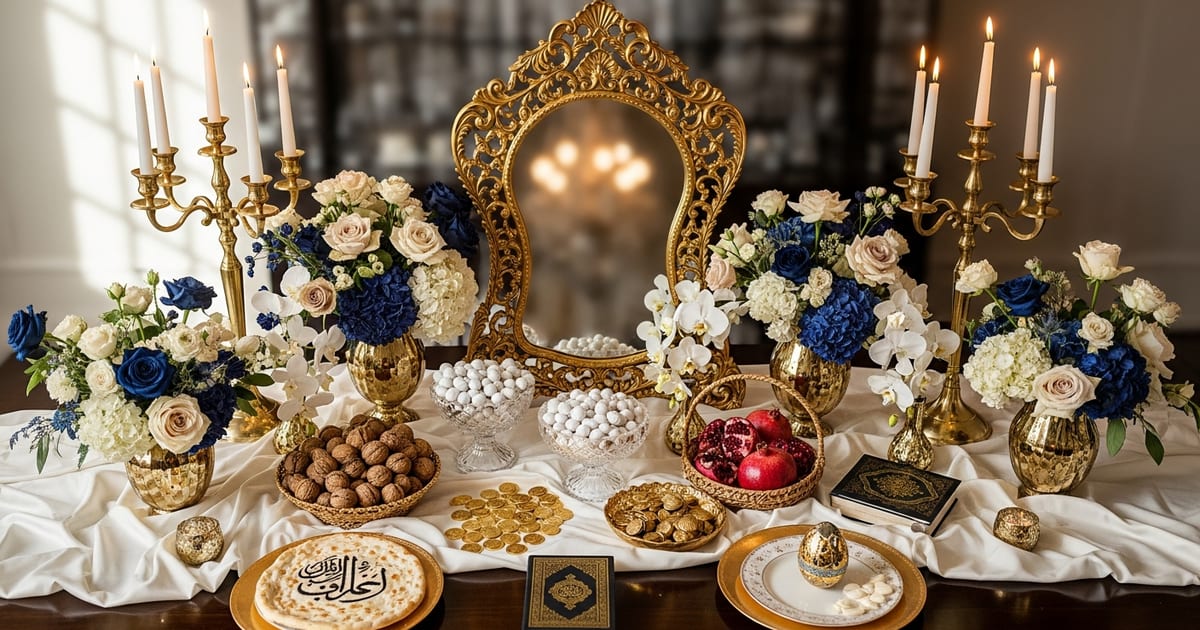
The Sofreh Aghd is the centrepiece of the Persian wedding ceremony — a ceremonial spread laid out on a fine cloth, traditionally termeh (a hand-woven Persian cashmere or silk fabric), arranged on the floor or a low table. The couple sits facing the spread and, behind it, a mirror. Every object placed on the Sofreh is symbolic. Nothing is decoration for its own sake. A skilled designer composes the whole thing as a single visual statement of light, sweetness, fertility, and protection.
Aineh-ye Bakht & Shamdan
The "mirror of fate" sits at the back of the Sofreh with a candelabra on each side. When the bride is seated, she lifts her veil and the couple's first reflection together appears in the mirror — a bright beginning. The candles represent fire, warmth, and the energy of the union.
Honey & Sugar Cones
A small cup of honey (asal) is shared the moment the couple is married — each dips a finger for the other to taste, so their life together begins sweetly. Above their heads, two sugar cones (kalleh ghand) are gently rubbed together over a cloth held by happily married women, showering sweetness onto the marriage.
Esfand & Rosewater
Wild rue seeds (esfand) are burned to drive away the evil eye and negative energy. Rosewater (golab), distilled from Persian roses, perfumes the air and is sprinkled to bless the gathering. Together they purify the space the couple will step into.
Around these anchors, the Sofreh fills with further symbols of a full and fertile life:
- → Noon-e Sangak (flatbread) — often inscribed with "Mobarak Bad" (congratulations) in seeds or saffron, symbolising prosperity and a life that never lacks bread.
- → Decorated eggs, almonds, walnuts & hazelnuts — fertility and a household that grows.
- → Pomegranates & apples — paradise, joy, and a fruitful union.
- → Sekkeh (gold coins) — wealth and prosperity for the new home.
- → A heavenly book — the Quran for Muslim families, or for secular couples the Divan of Hafez or the Shahnameh, placing wisdom and poetry at the centre of the marriage.
- → Needle & seven coloured threads — used to symbolically "sew up" the disapproving tongues of in-laws; the lightest, most affectionate moment of the ceremony.
- → A brazier of esfand and a cup of aragh-e beed meshk (willow water) — for calm, blessing, and protection.
No two Sofreh Aghd are alike. Some families keep them spare and traditional; others commission elaborate floral compositions with custom termeh, crystal, and gold leaf. This is exactly why a Persian wedding needs a dedicated Sofreh Aghd designer — not a generic florist who has seen a photo on the internet. The Sofreh is the single most photographed element of the day, and it is where cultural literacy shows.
The Full Timeline
A Persian wedding is a chain of distinct events. Depending on family, region of origin, and how observant the household is, some are combined and some are expanded — but the spine of the tradition looks like this:
The courtship visit. The groom's family formally calls on the bride's family to ask for her hand. Tea is served, families talk, and intentions are made clear. It is intimate — close family only — but it sets everything in motion.
The "taking of the yes." Once the families agree, terms are discussed — including the mehrieh (the marriage gift pledged to the bride) — and the engagement is sealed. Sweets are shared and the news becomes official.
The engagement party. A larger celebration where rings are often exchanged and the couple is formally introduced to extended family and friends as betrothed. Music, food, and dancing appear here for the first time.
The marriage ceremony itself, performed at the Sofreh Aghd. An officiant reads the marriage formula; the bride is traditionally asked three times before she answers; the honey is shared, the sugar cones are rubbed, and the couple is married. This is the spiritual and legal heart of the wedding.
The reception — the great celebration. A full Persian dinner, live music, the entrance of the couple, the knife dance for the cake, and hours of dancing. Often held the same day as the Aghd, sometimes a separate event entirely.
The planning implication is the one most Western tools miss completely: each event has its own guest list, its own venue or room, its own catering brief, and its own vendor assignments. The Khastegari might be twelve people in a living room; the Jashn-e Aroosi might be three hundred in a ballroom. A spreadsheet built for "the wedding day" simply does not have a place to put that. South Asian families face the very same problem on an even larger scale — we cover it in our South Asian wedding planning guide — and Chinese families navigate their own multi-event banquet structure in our Chinese wedding planning guide.
Who You Need To Hire
The difference between a beautiful Persian wedding and a stressful one is almost always the vendors. A generic directory will hand you a list of "wedding photographers" and "caterers." A Persian wedding needs specialists who understand the customs, the food, the music, and the rituals. Here is what the list actually looks like.
Sofreh Aghd Designer
The single most important Persian-specific vendor. They source the termeh, the mirror and candelabras, the symbolic items, and compose the spread. Many also supply the cloth held over the couple and the sugar cones. Book early — the best designers in Toronto, Vancouver and London are reserved a year out.
Aghd Officiant
Whether a religious officiant or a respected family elder, the person who performs the Aghd must know the liturgy, the three-question custom, and the rhythm of the ceremony. For secular couples, a celebrant fluent in the Hafez and Shahnameh readings.
Persian Caterer
Chelo kabab, zereshk polo ba morgh (barberry rice with chicken), sabzi polo, tahdig, and saffron everywhere. Persian catering is a craft of its own — rice alone is a skill. A generic banquet kitchen cannot fake it.
Persian Musicians & DJ
Live traditional players on the tar, santur, and daf for the Aghd; a bandari and 6/8 dance set for the reception. The right DJ knows when to move from classical Persian to Googoosh to the dance floor.
Persian Pastry & Tea Service
Bamieh, zoolbia, baghlava, nan-e berenji, and noghl — plus a proper saffron-and-cardamom tea service. The shirini table is a fixture, not an extra.
Culturally Literate Photo & Video
A photographer who knows to capture the mirror reflection, the honey moment, and the sugar-cone shower — not someone learning the ritual in real time and missing the shots that matter.
The Diaspora Market
The Iranian diaspora is large, established, and concentrated in exactly the cities where weddings.io operates. Los Angeles — affectionately "Tehrangeles" — holds one of the largest Iranian communities outside Iran. The Greater Toronto Area, sometimes called "Tehranto," and North Vancouver's deep Persian community make Canada a central market. London and the wider United Kingdom hold another substantial, well-rooted Persian population.
What unites these communities is a refusal to let distance dilute tradition. Families fly in from three continents. Sofreh designers ship termeh across borders. A bride in Vancouver and her aunts in Tehran plan over video call. This is a market that values custom precisely because it has had to work to preserve it — and it is profoundly underserved by mainstream wedding platforms that file every culture under a single generic template.
You can — and then you will spend hours explaining what a Sofreh Aghd is to vendors who have never heard the word, filtering through caterers who cannot make tahdig, and managing five events in a tool built for one. Cultural specificity is not a luxury feature for a Persian wedding. It is the whole job.
Planning Practicalities
Once you understand the structure, the practical work begins — and Persian weddings reward couples who plan backwards from the most contested resources. The Sofreh Aghd designer, the Persian caterer, and the live musicians are the three vendors most likely to be fully booked a year in advance in Toronto, Vancouver, and London. Lock those first. Everything else — flowers, transport, stationery, the cake — can flex around them.
Budget across a Persian wedding rarely behaves the way Western planning calculators assume, because the cost is spread across multiple events rather than concentrated on one. A modest Khastegari costs almost nothing; a large Namzadi can rival a small wedding; the Jashn-e Aroosi is usually the single biggest line item. Building a per-event budget — rather than one lump sum for "the wedding" — keeps families honest and prevents the reception from quietly consuming money that the engagement party already spent.
- → Book the Sofreh designer, caterer and musicians first. They are the scarcest culturally specific vendors.
- → Budget per event, not as one total — the Aroosi will dominate, so protect it.
- → Confirm the heavenly book early (Quran, Hafez, or Shahnameh) so the officiant and Sofreh designer align.
- → Plan the guest count per event. The Khastegari is family-only; the Aroosi can triple it.
- → Brief your photographer on the rituals — the mirror reflection, the honey, and the sugar-cone shower are non-negotiable shots.
- → Account for travelling family. Diaspora weddings draw guests from multiple continents; build the timeline with arrivals in mind.
One more thing nobody warns first-time couples about: delegation. A Persian wedding is traditionally a family project, and parents — especially on both sides — often carry the negotiation, the guest list, and a meaningful share of the cost. Decide early who owns which event and which decisions. Clarity at the start prevents the most common source of Persian wedding stress, which is not money or logistics but overlapping, well-meaning authority.
How We Serve It
weddings.io is the flagship of the Industry Army Marketing ecosystem — registered in 2015 and built deliberately to treat cultural weddings as first-class traditions rather than checkboxes. Persian is one of nine cultural wedding markets the platform supports, each with dedicated vendor categories and localised pages. For a Persian couple, that means a few concrete things.
The platform is built for multi-event weddings. Separate guest lists, venues, and vendor assignments for the Khastegari, Namzadi, Aghd, and Jashn-e Aroosi live in one system — not bolted onto a single-day template. Vendors are EyeSpyR™ verified, so the Sofreh designer and Persian caterer you find are accountable, real, and reviewed. AI matching connects you to vendors who actually understand Persian customs, and WhatsApp lead routing gets you talking to them quickly — which matters when your aunt's recommendation lives in another time zone.
Behind weddings.io sits a wider family of domains. weddings.ltd serves traditional and heritage weddings across the UK and Commonwealth. parents.ltd exists for the parents who carry so much of a Persian wedding's planning and cost. caterers.tv and videographers.io deepen the vendor pool, and insurancebrokers.io covers the protection a multi-event wedding deserves. It is one ecosystem, designed so that the authority of the hub lifts every specialist on it.
From the Sofreh Aghd to the last dance of the Jashn-e Aroosi, weddings.io connects you to verified Persian wedding vendors across Canada, the UK, and the US — built for the way Persian weddings are actually planned.