Chinese Wedding Planning Guide 2026: Tea Ceremony, Banquet & Tradition
From the morning tea ceremony to the nine-course banquet, a traditional Chinese wedding is a layered, multi-event celebration. Here is how to plan every part of it — and why the right platform treats it as more than a single date on a calendar.
A Chinese wedding is not one event. It is a sequence of them.
Plan a Chinese wedding the way you would plan a generic Western wedding — one ceremony, one reception, one guest list — and you will be unprepared for what the day actually demands. A traditional Chinese celebration unfolds across distinct moments: the gate-crashing door games at dawn, the tea ceremony where two families become one, the procession to fetch the bride, and the banquet of thirty, forty, sometimes sixty tables where the marriage is announced to the entire community. Each moment has its own customs, its own guests, and its own vendors.
This guide is written for couples planning a Chinese wedding in 2026 — particularly across the diaspora hubs of Canada and the United Kingdom, where Cantonese, Hokkien, Teochew, and Mandarin families have built some of the largest overseas Chinese communities in the world. Whether you are honouring full Cantonese tradition in Richmond or Markham, blending a Western white-dress ceremony with a tea ceremony in London, or planning across two cities and two cultures at once, the structure below will help you understand what to book, when to book it, and why the order matters.
It is also a guide to tooling. The reason so many Chinese couples find mainstream wedding apps frustrating is that those apps were never designed for a multi-event, multi-guest-list, multi-cuisine celebration. weddings.io — the flagship platform of Industry Army Marketing — was. We will show you where the platform fits as we go.
The Almanac & The Date
Choosing an auspicious date — and why it shapes everything else
Before a venue is booked or an invitation is printed, many Chinese families consult the Tong Sing — the Chinese almanac — or a fortune teller (sometimes a respected elder) to select an auspicious wedding date based on the couple's birth dates and the lunar calendar. Certain days are considered favourable for marriage; others are avoided entirely. The number 8 (發, prosperity) is prized, the number 9 (久, longevity) is welcomed, and the number 4 (死, which sounds like "death") is avoided in dates, table numbers, and guest counts alike.
This matters practically, not just symbolically. Because so many families chase the same handful of auspicious dates, banquet halls and the best Chinese caterers in any given city are booked twelve to eighteen months ahead for those days. The almanac effectively concentrates demand — which means your date decision and your venue decision are functionally the same decision, and both come first.
On weddings.io, the date sits at the centre of the planning workspace, and every vendor, deposit, and timeline anchors to it. When the date is fixed by the almanac, locking the venue and the banquet caterer to it immediately is the single most important early move you will make.
The Morning
Door games, the bridal fetching, and the moment the day begins
A traditional Chinese wedding day often begins long before the banquet — frequently before sunrise. The groom and his party (the brothers) travel to the bride's home to "fetch" her, and they are met at the door by the bridesmaids (the sisters), who refuse to let him in until he proves his devotion. These are the door games — chuangmen (闖門) — a beloved, often hilarious tradition of challenges, dares, and negotiation.
The sisters demand red envelopes (lai see / 利是) before each gate is opened; the brothers haggle, perform, and pay their way through. It is theatre, but it is meaningful theatre — a public demonstration that the groom values the bride and respects the family he is joining. Once he wins through, the couple may share a moment, and the procession moves to the next stage of the day.
- Red envelopes (lai see): prepare many, in small denominations, with auspicious amounts — favour numbers containing 8, avoid 4.
- A games coordinator or MC: someone to keep the door games lively, on schedule, and good-natured.
- A videographer and photographer: the door games produce some of the most joyful, candid footage of the entire wedding.
- Transport: the bridal car (often decorated, sometimes a luxury vehicle) and transport for the wedding party.
The Heart of It
The tea ceremony — when two families become one
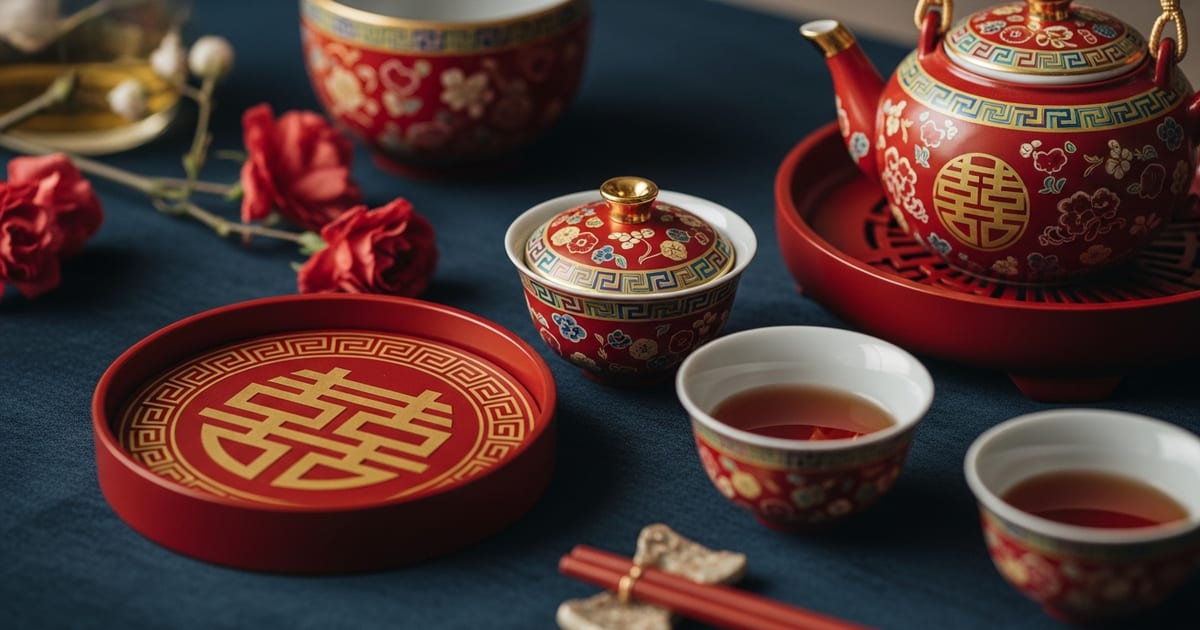
If a Chinese wedding has a single sacred centre, it is the tea ceremony (敬茶). This is the moment the couple formally honours their parents, grandparents, and senior relatives — kneeling or bowing, and serving each elder a cup of sweet tea, usually brewed with lotus seeds and red dates (a symbolic wish for a sweet union and for children soon). The elders drink, offer words of blessing, and in return present the couple with red envelopes or gold jewellery — bangles, necklaces, and the dragon-and-phoenix pieces that signify the union.
Order matters: the couple serves the most senior relatives first, working down through the generations, and addresses each elder by their correct familial title — a detail that means everything to the family and is worth rehearsing. The ceremony is often held twice, or in two parts, so that both the bride's family and the groom's family receive their due honour, typically in the morning before the banquet.
Many diaspora couples in Canada and the UK hold both — a tea ceremony to honour family and tradition, and a Western-style ceremony (white dress, vows, walk down the aisle) for the broader celebration. This is exactly the kind of two-ceremony, two-guest-list, two-outfit reality that generic single-event apps cannot model — and that weddings.io handles as separate, fully-budgeted events under one wedding.
For the tea ceremony you will need a tea set (often a gifted, auspicious red-and-gold set), the tea ingredients, a comfortable space with seating for elders, and a coordinator who understands the sequence. Many couples also engage a traditional dress specialist for this portion — which brings us to the attire.
The Attire
The qun kwa, the cheongsam, and the art of the outfit change
Chinese bridal attire is one of the most visually distinctive elements of the wedding, and most brides wear more than one outfit across the day. The two most significant traditional garments are the qun kwa (裙褂) — the elaborate two-piece dress, hand-embroidered with gold and silver dragon-and-phoenix motifs, traditionally worn for the tea ceremony and especially associated with Cantonese weddings — and the cheongsam / qipao (旗袍), the fitted high-collared dress often worn during the banquet.
The density of the gold embroidery on a qun kwa is itself a status and blessing symbol — the more complete the gold coverage (kwa with names like gwa wong for the most heavily embroidered), the more prestigious. The groom traditionally wears a changshan or a tang suit for the ceremony, often switching to a Western tuxedo for the banquet.
- → Qun kwa — tea ceremony and traditional portions of the morning
- → White wedding gown — if a Western ceremony is included
- → Cheongsam / qipao — banquet entrance and toasting the tables
- → Evening gown — optional final change for the banquet's later courses
Two or three outfit changes mean two or three hair-and-makeup looks, careful timing, and a vendor who specialises in Chinese bridal styling — including the traditional updo and accessories that complement a qun kwa. This is a culturally specific vendor category, not a generic "hair and makeup" listing, and finding the right specialist is one of the things a dedicated platform does well.
The Banquet
Eight courses, ten to a table, and the announcement of a marriage
The banquet is where a Chinese wedding becomes a community event. Guests are seated ten to a table, and the scale is often counted in tables rather than heads — a "forty-table wedding" means roughly four hundred guests. The meal is the centrepiece, and a traditional Chinese banquet menu runs eight or nine courses, each chosen for both flavour and symbolism.
Roast Suckling Pig
Often the opening course, symbolising the bride's purity and a prosperous start. A statement dish that signals the calibre of the banquet.
Whole Fish
The word for fish (魚, yú) sounds like "surplus" — a wish for abundance year after year. Served whole, head and tail intact, for completeness.
Lobster & Seafood
Lobster — the "dragon shrimp" — paired across the menu with the phoenix (chicken) to represent the harmony of the dragon-and-phoenix union.
Other courses commonly include a soup (shark-fin historically, though many modern, sustainability-minded families now choose seafood or fish-maw alternatives), abalone and sea cucumber for prosperity, a noodle or fried-rice course for longevity, and a sweet red bean or lotus dessert to end on sweetness. The exact menu varies by dialect group and region — Cantonese, Hokkien, and Teochew families each have their own emphases — and a good Chinese banquet caterer will guide the selection.
The banquet also carries its own choreography: the couple's grand entrance, often after the guests are seated; a toast at every table (yum seng — the drawn-out, full-throated toast led by the MC); the cutting of a cake; and the couple changing outfits between courses. A bilingual MC who can run the room in Cantonese or Mandarin and English is essential in diaspora weddings.
The Spectacle
The lion dance — driving out bad luck, ushering in joy
Few elements signal a Chinese wedding celebration like the lion dance (舞獅). Performed by a trained troupe to the thunder of drums, cymbals, and gongs, the lion dance is believed to drive away evil spirits and bad luck while welcoming prosperity and happiness. At weddings it often opens the banquet, greets the couple, or performs the cai qing ("plucking the greens") — the lion "eating" a head of lettuce containing a red envelope and lucky symbols, then scattering the leaves to spread good fortune.
A lion dance troupe is a specialist booking with real logistics: ceiling height and floor space at the venue, drum noise considerations, timing around the courses, and the lai see presented to the troupe. It is a vendor category that simply does not exist on most mainstream wedding directories — and exactly the kind of culturally specific listing weddings.io carries.
Vendor Categories
The vendors a Chinese wedding actually needs
Pull all of the above together and the vendor list for a Chinese wedding looks meaningfully different from a generic checklist. These are the categories that matter:
- Chinese banquet venue & caterer — priced per table, eight-to-nine-course menus, dialect-appropriate dishes.
- Lion dance troupe — drummers, performers, and the cai qing tradition.
- Qun kwa & cheongsam specialists — traditional dress rental or tailoring, including dragon-and-phoenix embroidery.
- Bilingual MC — to lead the yum seng and run the banquet in two languages.
- Chinese bridal hair & makeup — capable of multiple looks across the day.
- Tea ceremony stylist / coordinator — tea sets, lotus seeds, red dates, and sequence.
- Photography & videography — covering door games, tea ceremony, and banquet as distinct chapters.
- Floral & stage décor — red and gold palettes, double-happiness (囍) motifs, dragon-and-phoenix detailing.
On weddings.io, every one of these is a real, searchable category with vendors verified through EyeSpyR™ — our vendor accountability layer that helps couples avoid deposits-and-disappear horror stories. For the catering itself, the ecosystem extends to caterers.tv; for the film, videographers.io; and for the room, decorator.tv. Wedding insurance — well worth it for a forty-table banquet with sizable deposits — runs through insurancebrokers.io.
The Platform
Why weddings.io handles a Chinese wedding the way it should be handled
The core problem with planning a Chinese wedding on a mainstream app is structural. The Knot, Zola, and WeddingWire were built around a one-ceremony, one-reception, one-guest-list template. A Chinese wedding breaks that template the moment you add a separate tea ceremony, a banquet counted in tables, a Western ceremony for some guests, and three outfit changes.
weddings.io models the wedding as a set of distinct events — door games, tea ceremony, optional Western ceremony, banquet — each with its own guest list, its own vendors, its own timeline, and its own budget line. It manages the large guest counts a banquet demands (the platform is built to handle 800-plus guests), tracks deposits across every vendor, and routes vendor enquiries via WhatsApp so couples and suppliers can communicate the way they actually do. The AI matching layer connects couples to the lion dance troupes, qun kwa specialists, and banquet caterers in their own city.
And it is global. weddings.io serves 1,018 cities across 24 countries, with real depth in the Chinese diaspora — Vancouver and Richmond, Toronto and Markham, London and Manchester, and beyond. The same dedicated, culture-first approach powers the rest of the ecosystem: read our South Asian wedding planning guide and our Persian wedding planning guide to see how the platform serves each tradition on its own terms rather than flattening them into a generic template.
weddings.io is the flagship of a 150+ domain network owned by Industry Army Marketing, Vancouver BC — a model first proven on industryarmy.com domains like gasfitter.ca in 2007 and documented in Business in Vancouver around 2010. The traditional-wedding companion weddings.ltd, the family-of-the-couple resources at parents.ltd, and the bride and groom hubs at brides.ltd and grooms.ltd all sit alongside it. The point is simple: a Chinese wedding deserves a platform that knows what a tea ceremony is.
Plan a Chinese Wedding the Way It Is Actually Celebrated.
Tea ceremony, banquet, lion dance, and every outfit change — modelled as the multi-event celebration it really is, with culturally specific vendors verified through EyeSpyR™, across 1,018 cities and 24 countries.