The South Asian Wedding App: How Weddings.io Runs Five Functions in One System
A South Asian wedding is not one event — it is five. Mehndi, Sangeet, Baraat, Ceremony, Reception, each with its own guest list, dietary plan, vendors, seating, and timeline. Here is the technical reason generic wedding apps collapse under that load — and how the weddings.io app was built to carry it.
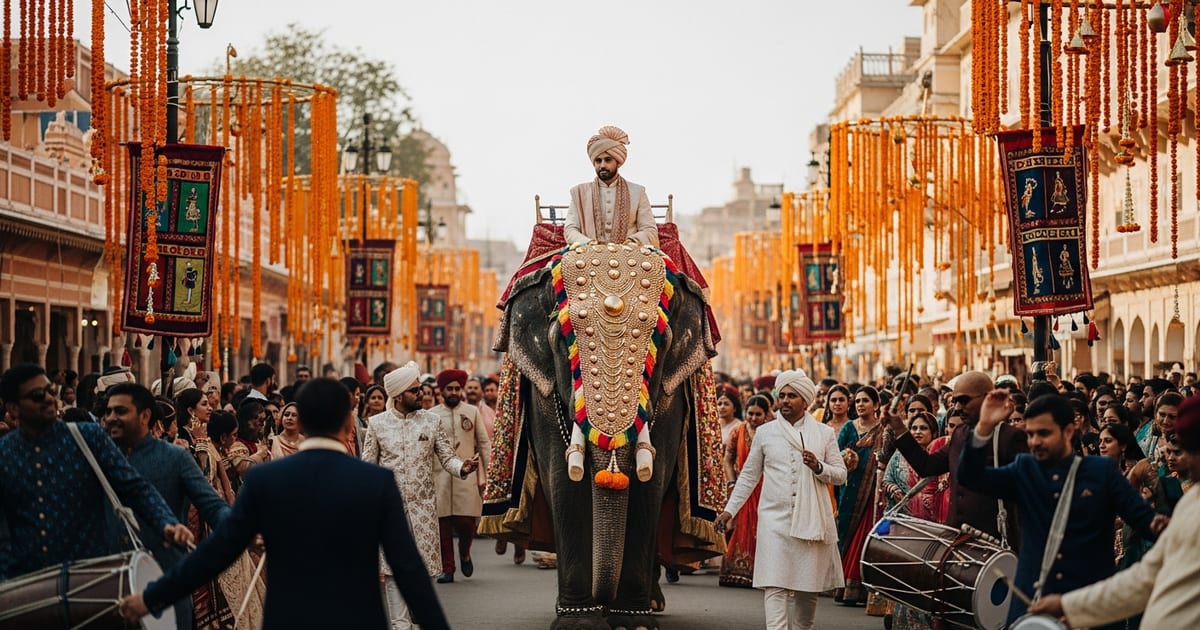
A South Asian wedding is not a wedding. It is five weddings that happen to share a couple.
Open almost any mainstream wedding app and the first screen asks you the same question: what is your wedding date? Singular. One date. One venue. One guest list. That single assumption — that a wedding is one event — is the precise point where every generic planning tool fails a South Asian family, because a South Asian wedding is a sequence of distinct, ticketed, fully staffed functions that can run across three, four, even five days.
The Mehndi. The Sangeet. The Baraat. The Ceremony. The Reception. To the family living it, these are not "parts" of one party. Each is its own production with its own guest list, its own dress code, its own venue, its own caterer, its own décor brief, its own music, its own timeline, and its own budget. The Mehndi might be 150 close family at home. The Sangeet might be 400 with a live dhol and a choreographed dance floor. The Reception might be 800 in a banquet hall with a plated dinner and a seating chart that has to respect family politics three generations deep.
Try to model that in a tool built for "one date, one venue, one list" and you end up doing what millions of South Asian families have done for years: abandoning the app and rebuilding the entire wedding in a tangle of spreadsheets, group chats, and a shared note that nobody trusts. That is not a small inconvenience. On the most expensive and emotionally loaded event of a family's life, it is the difference between control and chaos.
The weddings.io app was architected from the opposite assumption. Not "a wedding is one event" but "a wedding is a set of connected events." That single design decision is why it can run a five-function, 800-guest South Asian celebration in one system — and why the apps built for The Knot's idea of a wedding cannot.
Five Functions, Five Engines
Each function is a first-class event — not a tab, not a note, not a workaround.
The technical heart of the platform is this: inside a single wedding, every function is its own complete event object. It carries everything a standalone event would carry, and it stays connected to the others so the family sees one coherent picture instead of five disconnected ones.
Mehndi
Intimate, often at home. Henna artists, a smaller curated guest list, lighter catering. Its own RSVP state — a guest invited here may not be invited to the Sangeet, and the app holds that distinction cleanly.
Sangeet
Music, dance, dhol, performances. Larger list, a real stage and sound brief, a run-of-show with rehearsal slots. Catering scaled up, dietary counts recalculated for exactly the guests attending this night.
Baraat & Ceremony
The procession and the rites. Mandap build, priest or officiant timing, horse or car logistics, precise sequencing. The function the entire timeline pivots around — and the one where minutes matter.
The Reception then becomes the largest event of the set — frequently 600 to 800 guests — with a plated or buffet dinner, a head table, a stage, a dance floor, and a seating chart that is its own multi-day project. In the weddings.io app these five are not five separate planning files. They are five events inside one wedding, sharing one master guest database, one vendor directory, and one budget — but each resolving to its own attendance, its own counts, and its own timeline.
A South Asian wedding has five dates, five guest lists,
five dietary plans, and five budgets.
The weddings.io app was built to ask the right question.
Guests at Scale
800+ guests, and a guest who is at the Reception but not the Mehndi.
Guest management is where most tools quietly break. It is one thing to hold a list of 800 names. It is another to hold 800 names where each person has a different relationship to each function. Grandparents and immediate family are at the Mehndi. Family friends and the bride's colleagues join at the Sangeet. The full extended community — 800 strong — arrives for the Reception. The same human appears in one, two, or all five functions, and their RSVP can differ for each.
The weddings.io guest engine models this directly. Every guest is a single record — one source of truth for their name, contact, household, and dietary flags — but their attendance is tracked per function. RSVP to the Sangeet is independent of RSVP to the Reception. Household groupings keep families together so a party of seven does not get scattered across the data. And because the record is unified, updating a phone number or a dietary note once updates it everywhere that guest appears.
- → Per-function invitation and RSVP state — invited to the Reception, not the Mehndi, and the data knows the difference
- → Household and family groupings so parties stay together across every list and every seating chart
- → Dietary flags — Jain, Halal, strict vegetarian, Kosher, allergies — carried into every function the guest attends
- → Side and relationship tags (bride's side, groom's side, family, friends, colleagues) for balanced seating and counts
- → Contact details wired into RSVP follow-up and WhatsApp-based communication
This is the difference between a list and a system. A list tells you who is invited. A system tells you that 412 people are confirmed for the Sangeet, 78 of them are vegetarian, 31 are Jain, 12 flagged a nut allergy, and 9 of them are the photographer's crew who need a vendor meal — and it tells the Sangeet caterer exactly that, without anyone re-counting a spreadsheet at midnight.
Dietary at Function Level
Jain, Halal, Vegetarian, Kosher, allergy — counted per function, not per wedding.
Dietary requirements in a South Asian wedding are not a footnote. They are a planning discipline. A single guest list can contain strict Jain guests (no root vegetables, no onion or garlic), Halal requirements, lifelong vegetarians, Kosher observers, and a long tail of allergies. Get the counts wrong and you do not just inconvenience a guest — you can leave an elder with nothing they can eat at a wedding their family has waited their whole life to host.
The weddings.io app attaches dietary flags at the guest level and then resolves them at the function level. Because each guest's attendance is tracked per event, the catering count for the Mehndi reflects only the people actually at the Mehndi, and the Reception count reflects only the Reception crowd. When you assign one caterer to the Sangeet and a different one to the Reception — extremely common in South Asian planning — each vendor receives the dietary breakdown for their event, not a single blurred number for the whole wedding.
Because your caterers are different per night and your guests are different per night. The 400 at the Sangeet are not the 800 at the Reception, and their dietary mix is not the same. A single wedding-wide count over-orders for one function and under-orders for another. Per-function dietary resolution is the only way to brief each caterer accurately — and it is exactly what the platform was built to do.
Vendors, Seating & Budget
Specialist vendors, a real seating geometry engine, and per-function money.
South Asian weddings run on specialist vendors that mainstream directories barely list: mandap builders, dhol players, henna and mehndi artists, bridal makeup specialists who understand bridal jewellery and dupatta setting, and halwai-style caterers who can cook for hundreds. The weddings.io app lets you assign vendors to specific functions — this décor team for the Sangeet stage, that mandap builder for the Ceremony, this caterer here and that caterer there — so responsibilities are never ambiguous and no vendor is briefed on the wrong night.
Seating is its own engine. For an 800-guest Reception, the platform's seating geometry tools let you build the room — round tables, head table, stage proximity — and place households and sides while honouring the family relationships the data already knows. Because seating draws on the same guest records, a late RSVP change or a swapped table flows through without a manual rebuild.
And budget is tracked per function. The Mehndi, Sangeet, Baraat, Ceremony, and Reception each carry their own budget lines, so a family can see what the Sangeet stage and live dhol actually cost versus what the Reception dinner ran — and see the total at the same time. Per-function budgeting is how families keep a five-event celebration from quietly spiralling, because every line is attributed to the function that incurred it.
| Capability | weddings.io app | Generic wedding app |
|---|---|---|
| Event model | Five functions, each a first-class eventBuilt for it | One date, one venue, one listWorkaround |
| Guest scale | 800+ with per-function RSVP | One global guest list |
| Dietary | Jain / Halal / Veg / Kosher / allergy, per function | Single wedding-wide count, if any |
| Vendors | Assigned per function, specialist categories | Generic vendor list, no function mapping |
| Seating | Geometry engine, 800-guest Reception | Basic or none |
| Budget | Per-function budgeting + total | One lump budget |
| Vendor trust | EyeSpyR™ verificationAccountable | Unverified listingsBuyer beware |
Vendor Trust
EyeSpyR™: because deposits on a mandap and a halwai are not small money.
South Asian weddings carry concentrated financial risk in their vendors. Specialist suppliers are booked many months ahead and paid significant deposits — the mandap builder, the bridal makeup artist, the caterer cooking for 800, the dhol and the décor. A no-show, a misrepresentation, or a vanished deposit on any one of them is not a minor setback; it is a wound on the wedding itself.
This is what EyeSpyR™ exists to address. It is the verification layer built into the weddings.io platform that confirms vendor legitimacy and accountability, so families committing large deposits to specialist suppliers are not exposed to the failure modes that quietly haunt the South Asian market. Combined with the platform's AI couple-to-vendor matching and WhatsApp-based lead routing — the channel South Asian families already live on — it means the right verified specialist reaches the family quickly, on the platform they trust.
Why It Exists
Built by the ecosystem, not bolted on as a "cultural section."
The reason the weddings.io app can do this is that it was never treated as an afterthought. The South Asian market — an estimated $6–9 billion annually in North America — is one of the most underserved segments on legacy platforms, which tend to add a "cultural" filter and call it done. Industry Army Marketing built for it at the architecture level, and surrounds it with a dedicated ecosystem: shaadi.ltd as the South Asian platform, parents.ltd for the families who carry so much of the planning and the cost, and the wider 150+ domain network — weddings.io, weddings.ltd, brides.ltd, grooms.ltd, caterers.tv, decorator.tv, and insurancebrokers.io — that connects couples to verified specialists across 1,018 cities and 24 countries.
If you want the deeper cultural planning context — the full structure of the functions, the vendor categories, and how families budget across cultures — read our South Asian wedding planning guide for 2026 and the story of why a dedicated platform matters in why shaadi.ltd exists. This post is about the engine. Those are about the experience the engine makes possible.
The platform itself is not a promise. It is a verified production stack — 38 files, a 2.64MB JavaScript bundle, 45 live routes, confirmed by direct file inspection on June 27, 2026 — running the guest, dietary, vendor, seating, and budget systems described here. It is live now, and it is the only wedding app we know of that treats a five-function South Asian wedding as exactly what it is: five real events, in one connected system.
Five Functions.
One System.
Built for the Way You Actually Get Married.
Mehndi, Sangeet, Baraat, Ceremony, Reception — each with its own guests, dietary plan, vendors, seating, and budget. 800+ guests. EyeSpyR™ verified specialists. AI matching. Live now on the platform that was designed for it.